
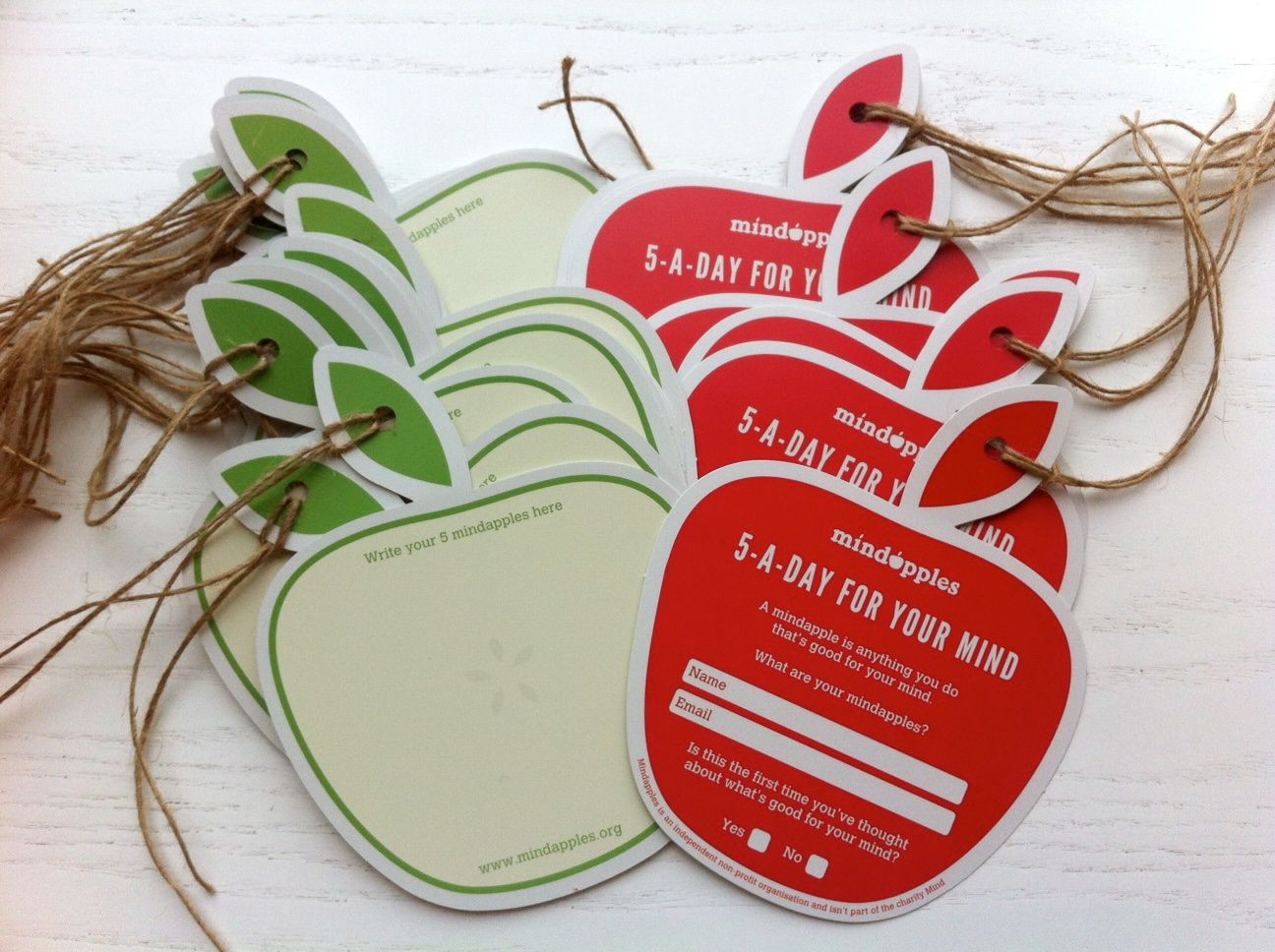
For years, Mindapples have been placing small apple-shaped cards in the hands of students and staff in schools across the country and asking them a simple question:
“What are the five things you do each day that are good for your mind?”
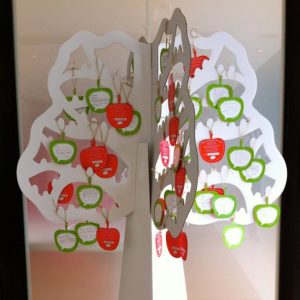
People write their answers by hand, and the cards go up on a tree or in communal spaces around school. We’ve been thinking about why writing something down by hand and seeing it displayed alongside other people’s ideas seems to do something that digital activity doesn’t quite replicate.
In 2023, UNESCO reviewed the global evidence on digital technology in education and concluded that there was little clear evidence that it was making a meaningful difference to how well young people learn. They called for smartphones to be used in schools only when they clearly supported learning outcomes with UNESCO’s Director-General adding, “Technology should be seen as a means, never an end”. And schools across the UK and beyond have been asking questions about what screens offer to teaching and learning. But, this blog is less about what screens can’t do and more about what creative, physical, shared, perhaps even “analogue” experiences can do for our learners, starting with what happens when we offer a pen to someone and give them space to think.
What writing by hand does
Research from Keio University in Tokyo found that writing in a paper notebook made it more likely for information to be remembered, rather than using a tablet or a smartphone. When we write by hand, we can’t capture everything, so we have to slow down and choose what matters. A 2025 review of neuroimaging research also confirmed this, that writing by hand engages way more of the brain than typing does. The physical act of forming words on paper calls on motor control, sensory experience and conscious thought all at the same time!
Why participation and creativity make a difference
The same principle applies to how we support young people’s wellbeing. Being told something is different from being invited to engage with it and contribute to it. That active involvement creates space for young people to develop their own thoughts and ideas.
Research published earlier this year found that young people who participate regularly with creative and arts-based activities can have improved mental health, including being better able to cope with stress, having stronger social connectedness and improved emotional wellbeing. Creative, participatory approaches, where young people reflect and contribute ideas alongside one another, as we do in Mindapples sessions, are part of what makes that possible.
It’s important to acknowledge that different approaches work for different people. For some students and staff, particularly those with certain learning needs, digital tools offer an accessible and important way to learn. We’re not arguing that one is better than the other, more reflecting that physical and creative approaches offer something distinct that’s worth holding onto.
What shared space does
Another way to think about this is when an applecard goes up on a tree in reception or a wall display in a corridor it stops being only an individual reflection, and becomes part of something shared.
Collective and relational approaches to wellbeing in schools are more effective for children’s mental health than individual ones alone. Having a sense of belonging and community matters and the environment we’re in, be it what’s on the walls or visible in the communal spaces and corridors helps to shape this further.
What we saw at Beckmead
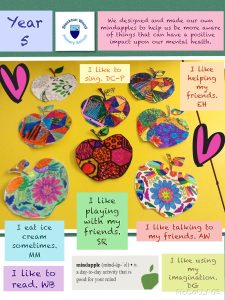
At Beckmead College in South London, we run regular Mindapples sessions with students and staff as part of their whole-school approach to mental health. In one session, students were given our applecards and asked to write down their own mindapples: the everyday things that help them look after their minds. They wrote about dancing, listening to music, going to the gym, spending time with friends, giving back to their community. The cards were added to a Mindapples tree in the school reception, for everyone who walked through the doors to see.
Dawn Fortt, Senior Mental Health Lead at Beckmead, described what happened next.
“When you brought the apples in and they had to write on it, that was different.”
“It initiated conversation. We were able to carry on talking about it afterwards.”
The conversations around mental health and wellbeing didn’t end when the session did, their students came back to the ideas they’d shared with peers, the staff were all talking about it and the parents noticed the tree when they came into school too.
How Mindapples can help
Our Mindapples for Schools toolkit includes apple-shaped cards for students and staff to write their mindapples on, alongside posters, guides and resources to help make mental health and wellbeing part of everyday school life. The applecards are also available to buy separately and can be displayed on a Mindapples tree in a communal area, or used as part of a wider creative project in school. Some schools make their own tree.
 .
. 
If you would like to find out more about our schools programme or order resources, visit our shop or get in touch at schools@mindapples.org